


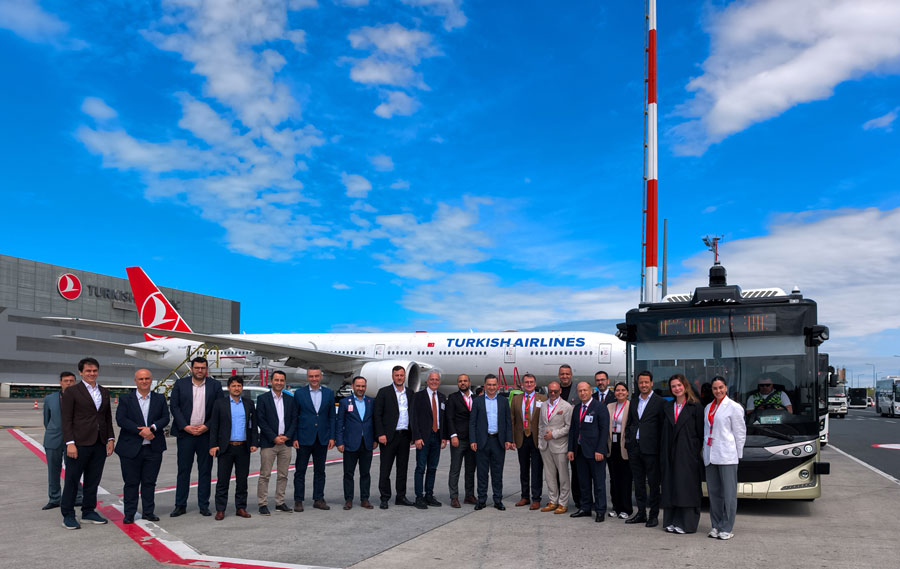

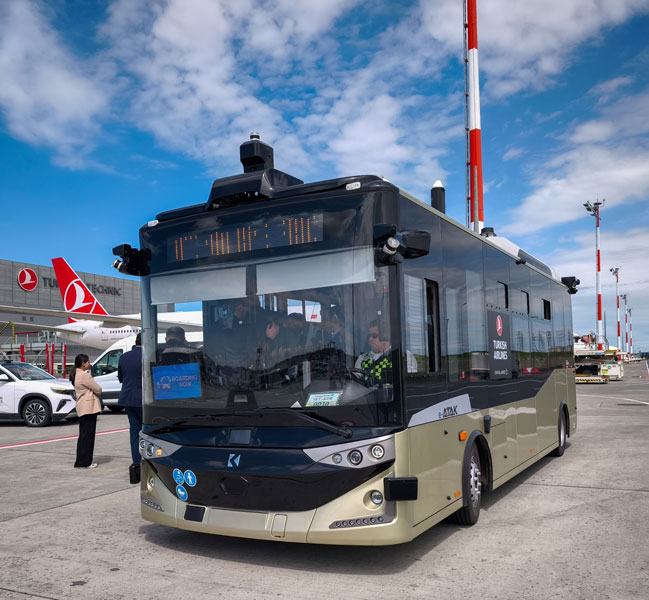
With its vision of “Being One Step Ahead in the Future of Mobility,” Karsan, a pioneer in the global transformation of public transportation, continues to showcase the latest advancements in autonomous technology. As the world’s first Level 4 autonomous public transportation vehicle, the Karsan Autonomous e-ATAK has been in service under real-world road conditions since 2021 and has now proven its ability to achieve success in public transportation across various operational use cases. In this context, the company conducted a demo operation at IGA Istanbul Airport in collaboration with its technology partner ADASTEC and Turkish Airlines. The Karsan Autonomous e-ATAK was tested under real operational conditions on the apron along an 11-kilometer route. The demo runs were designed around two different scenarios. In the first scenario, the vehicle traveled from the starting point at the Turkish Airlines Operations Center – Crew Terminal to the Smart Cargo Area (in front of the SMARTIST Building). In the second scenario, the vehicle traveled from the same starting point at the Turkish Airlines Operations Center – Crew Terminal to the 200 Series Open Parking Area. These scenarios, which simulated the transportation of shift crews to their work areas and flight crews to their aircraft parking positions, provided important data regarding the validation of autonomous driving performance under real operational conditions, the testing of perception and navigation systems, the evaluation of safety and emergency scenarios, and the analysis of operational traffic interactions.
Operating alongside other service vehicles on the apron amidst actual operational traffic, the Karsan Autonomous e-ATAK successfully completed its route using its LiDAR, radar, cameras, and advanced sensor systems, thereby demonstrating the potential of autonomous technology in air cargo logistics.
“We have clearly demonstrated the potential of autonomous technology“
Karsan Deputy General Manager of Domestic Sales and External Relations Muzaffer Arpacıoğlu, stated that this important test clearly revealed the capabilities of autonomous technology in a real-world operational environment and the potential for digital transformation in the aviation sector, saying, “We recently successfully completed a two-week demo operation with the Autonomous e-ATAK at Frankfurt Airport. Now, with this successful demo at IGA Istanbul Airport, we have clearly demonstrated the long-term potential of autonomous mobility in apron operations,” he said. Noting that aprons are high-security areas, Muzaffer Arpacıoğlu continued: “In this context, the Karsan Autonomous e-ATAK has strongly addressed the needs for operational efficiency, minimizing human error, enhancing safety standards, and advancing digitalization and automation. We view this successful demo as a strategic step in demonstrating that autonomous technology can be applied not only in public transportation but also in various operational use cases.”
At a meeting attended by teams from Karsan, Turkish Airlines and ADASTEC, following evaluations of passenger transportation and security processes within the apron, a demonstration drive shedding light on future mobility solutions was conducted on the apron.
Following the meeting, Turkish Airlines Deputy General Manager Kerem Kızıltunç stated: “As Turkish Airlines, we have once again taken the lead in the industry by conducting the first autonomous bus demonstration on an airport apron in Turkey. Using autonomous buses developed in collaboration with Karsan Otomotiv and ADASTEC, we completed this test drive for our airport operations, a 11-kilometer route that began at our Crew Terminal, stopped at our Smartist cargo building, and continued to open parking positions entirely autonomously.
“It was truly exciting to test this technology on the tarmac, the heart of aviation, as a pioneer in the field and to personally experience autonomous driving in a safe manner. I would like to thank everyone who contributed to this project.”
Atalay Taşkoparan, Co-Founder and CCO of ADASTEC, emphasized that the company offers reliable, scalable, and field-proven solutions for airport operations using its Level 4 autonomous driving technology, stating: “IGA is the busiest airport in the European Union. Here, using the Karsan Autonomous e-ATAK equipped with ADASTEC’s autonomous driving technology, we implemented a personnel transport scenario under real traffic conditions. The scenario focused on the transportation need between the terminal building and the aircraft. The autonomous vehicle’s performance in a real-world traffic environment was projected to offer a viable solution that meets operational efficiency and safety expectations for crew transportation on the apron. Based on the field experience we have gained in various airport projects, we believe that autonomous mobility will resolve a range of issues in aviation operations and play a significant role. As ADASTEC, we are pleased to contribute, together with Karsan, to the transformation of airports focused on safety, efficiency, and sustainability. We invite airports around the world to join us in shaping the operations of the future.”
The world’s first and only vehicle with 60,000 passenger trips
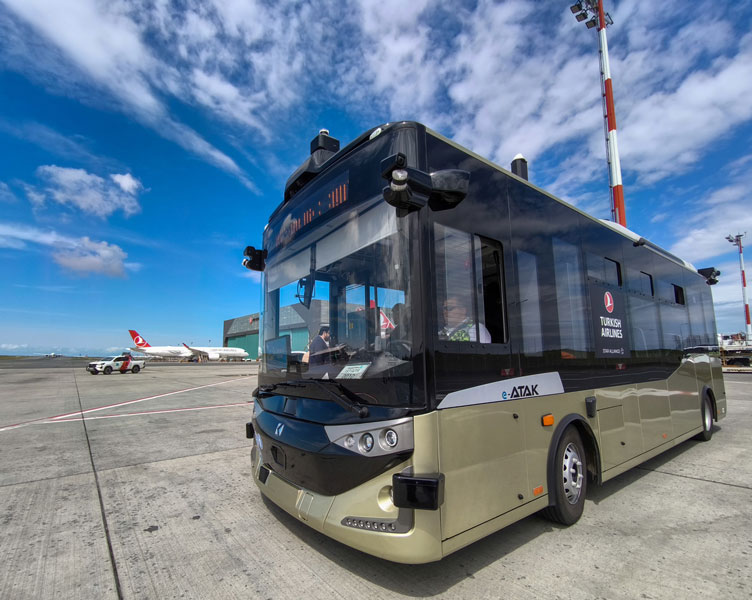
As autonomous technology plays an increasingly vital role in transforming mobility, the Karsan Autonomous e-ATAK is achieving significant milestones by transporting passengers under real-world traffic conditions through projects implemented in Europe and the U.S. In the U.S., the vehicle has been transporting passengers along a 5-kilometer route on the Michigan State University campus for 1.5 years, while in Stavanger, Norway, it has been carrying ticketed passengers since 2022 and has garnered attention as the first autonomous bus to pass through a tunnel.
Karsan, which launched Europe’s first autonomous airport shuttle in Rotterdam, has also implemented the first autonomous bus projects carrying passengers in open traffic in Switzerland and Sweden, while in Hannover, it became the first autonomous bus to conduct test drives on public roads with KBA approval. The autonomous apron demonstration conducted in Frankfurt demonstrated Karsan’s capability to provide autonomous mobility solutions in high-security and precision-demanding areas such as airport operations. Along with autonomous demonstration projects in Salen and Paris RATP scheduled for 2026, Karsan will continue to develop its autonomous technology across various use cases.
With over 160,000 kilometers of autonomous driving experience, more than 60,000 passengers transported, and a 99.5% success rate, Karsan remains the world’s first and only Level 4 autonomous bus operating in public traffic, currently involved in 16 different autonomous projects across 12 countries.
Karsan Autonomous e-ATAK is always ready for service
Equipped with an Advanced Sensor Package, the Karsan Autonomous e-ATAK uses a combination of LiDAR, radar, cameras, GNSS, and state-of-the-art sensors that work together to provide precise navigation and situational awareness in various weather conditions. Capable of autonomous driving at speeds up to 40 km/h day or night under various weather conditions, the vehicle performs all the tasks typically handled by a bus driver, such as pulling up to stops along the route, managing boarding and alighting processes, and directing traffic at intersections, crossings, and traffic lights, all without a driver. The bus’s ability to fully charge in 5 hours using AC units and in 3 hours using DC units ensures the vehicle is always ready for service.







[…] from June 17–19, presenting the Autonomous e-ATAK, e-ATA 12, and e-ATA 18 models to visitors. The Autonomous e-ATAK, the world’s first Level-4 automated bus to transport passengers on a scheduled route, represents […]